Ball Valves: The Unsung Heroes of Fluid Transport
In our modern world filled with all kinds of technical innovations, smaller components that keep these systems running efficiently often go unnoticed. An automotive engineer may know the importance of their function, but to a commoner, they may just be a bunch of metal pieces. Having stated that, let’s shine some light on one such inconspicuous but significant device – the ball valve.
Origins and Application of Ball Valves
Ball valves are an imperative part of pipelines, working as innate regulators for controlling the flow of liquids and gases[^1^]. Its invention can be traced back to the late 1950s, and today, these simple yet effective devices are utilized across several sectors such as oil and gas, chemical processing, and pharmaceuticals, to name a few.
Anatomy of Ball Valves
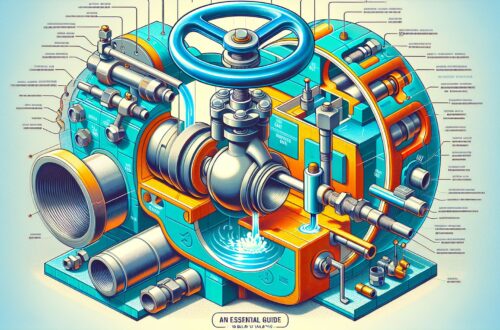
A ball valve consists of a valve body, a rotatable ball placed inside this body, and valve seats that form a seal when the valve is in the off position[^2^]. The ball has a hole or port through its axis which, when in line with both ends of the valve, allows the flow of fluid. Turning the ball to an angle of 90 degrees stops the fluid flow, giving the valve its function of a shut-off valve. These valves may be designed as full bore, where the hole dimensions equal the inner dimensions of the connected piping, or reduced bore, with a smaller hole size.
Why Choose Ball Valves?
The primary reason for a large scale adoption of ball valves has been their many apparent advantages. They have a long service life and provide reliable sealing even after long periods of disuse. They offer fast and easy operation as switching off flow is as simple as a quarter-turn. Furthermore, they are versatile and can be used for a wide array of applications, from low-pressure to high-pressure systems and from cold to high-temperature operations.
Additionally, their straightforward design reduces the possibilities of malfunctioning, resulting in a low maintenance requirement and therefore a lower cost in the long run.
Selection and Installation
Selection of a ball valve chiefly depends upon its application. Factors to consider include the nature of the transported fluid, pressure and temperature conditions, and the requirement of a full or reduced bore.
A ball valve, once chosen, needs to be installed correctly and should be operated periodically to ensure its proper working and a longer lifespan[^3^]. The valve’s handle provides easy identification of its current position, where a turned handle signifies a closed valve and an in-line handle signifies an open valve. For optimal functioning, it is essential to keep the valve either fully open or fully closed. Leaving it partially open may result in erosion and eventual failure of the valve.
Potential Shortcomings
While ball valves have several advantages and a wide range of applications, they are not free from potential problems. For instance, they are not well-suited for gradual flow control and can be damaged if used as throttling valves. Additionally, even though they can withstand pressure, under severe pressure changes, the ball and the seats may become warped, leading to leaks.
Conclusion
Although simple-looking, ball valves play an essential role in various industries by making flow control much more efficient and straightforward. By understanding their construction, advantages, proper selection, and installation, you enable your system to run smoothly and save time and resources that would otherwise be spent on maintenance and repair.
Next time you turn on a gas stove or hear about oil refineries, spare a thought for the humble ball valve. Without its contribution, controlling the flow of fluids would be a much more complicated task.
References
[^1^]: Engineering Toolbox. (n.d.). Ball Valves. https://www.engineeringtoolbox.com/ball-valves-d_1984.html
[^2^]: Valve Campus. (2018). Ball valves: what are they?. https://www.valvecampus.com/blog/ball-valves-what-are-they/
[^3^]: Y strainers & Basket strainers. (2009). Ball valves – operation, maintenance and troubleshooting. https://www.y-strainer-valve.com/ball-valves-maintenance-and-troubleshooting.html