Gate Valves
Unlocking the Mystery of the Mighty Gate Valve
Gate valves, also known as sluice valves, are a staple in various industrial, commercial, and residential applications. They are especially known for their ability to tightly seal off flow paths, thus making them an ideal choice in pipelines requiring either a strict flow isolation or an unimpeded straight-line flow. So, how do these fascinating instruments work? Read on to find out!
How Gate Valves Work?
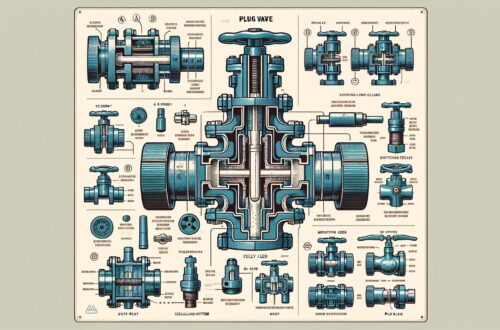
Gate valves function through a movable “gate” (or wedge) that moves either up or down, without turning against a seal. This moving gate aligns perfectly with the flow passage when fully opened, offering minimal obstruction to the flow. Conversely, the gate covers the opening entirely while in the closing position to stop the flow.
Positioning is Key
The positioning of gate valves is absolutely crucial – they are typically installed either fully open or fully closed. This feature, also termed as “not for throttling,” is primarily because the high velocity of fluid against a partially open gate can cause significant erosional damage.
Different Types of Gate Valves
Wedge Gate Valves – These are the most common type of gate valves, particularly for dealing with high pressure and high temperature.
Knife Gate Valves – This special form of gate valves are designed with a sharp-edged gate ideal for “cutting” in slurry or viscous fluid applications
Parallel Gate Valves – Named for their gate design which has two parallel discs/plates controlling the flow.
Gate Valves vs. Other Valves
Gate valves are often compared with other valve types like Globe and Ball valves. The primary advantage of gate valves is the unobstructed full bore flow they allow, ensuring negligible pressure losses. It makes them suitable for applications where flow efficiency is a top priority.
Specification of Gate Valves
Material : Gate Valves can be made out of various materials, including Brass, Bronze, Cast Iron, Ductile Iron, Stainless Steel, and Alloy Steel.
Size: Varying from 2″ to 60″ (50mm to 1500mm), gate valves can be used in small home applications to massive industrial fluid systems.
Pressure Class: Pressure classes range from 150# to 2500# in accordance with ASME B16.34.
Applications
Gate Valves are widely used from general services to extreme acidic conditions. Some examples are Water Services, Wastewater (Sewage) Treatment, Fire Protection, Petroleum Refining, Petrochemicals, and Power Industries.
Installing and Maintaining Gate Valves
Gate Valves, like every other piece of equipment, require periodic attention and maintenance to keep them working efficiently. This might include routine inspections, tightening of bolts and nuts, and checking for leakage. If a valve malfunctions, it would require repair or replacement, and routine maintenance helps to avoid such disruptions.^[1^]
Environment, Safety and Standards
Gate valves are also subject to a series of standards and tests. Standards such as ISO 5208 (Leakage Rate), API 598 (Shell and Backseat Test), ASME (Hydrostatic Test) are followed and certified.^[2^]
In Conclusion
Gate Valves are a simple, efficient, and reliable solution to various flow control needs. The key lies in understanding their operation, properly installing, and maintaining them.
Who knew that tiny “gates” could play such a critical role in managing our world’s fluid-flow systems? To quote Plato, “The measure of a man is what he does with power.” and in this context, these mighty gate valves sure hold a lot of power!
Sources:
-
“Gate Valve Maintenance & Repair.” DFT Valves. https://www.dft-valves.com/blog/gate-valve-maintenance-repair/
-
“A Comprehensive Overview of the Gate Valves’ World.” Reliable Valves. https://reliablevalves.com/gate-valves-overview/
-
“A detailed introduction to gate valves.” REGENT VALVES. http://regentvalves.com/blog/a-detailed-introduction-to-gate-valves/